Episode Transcript
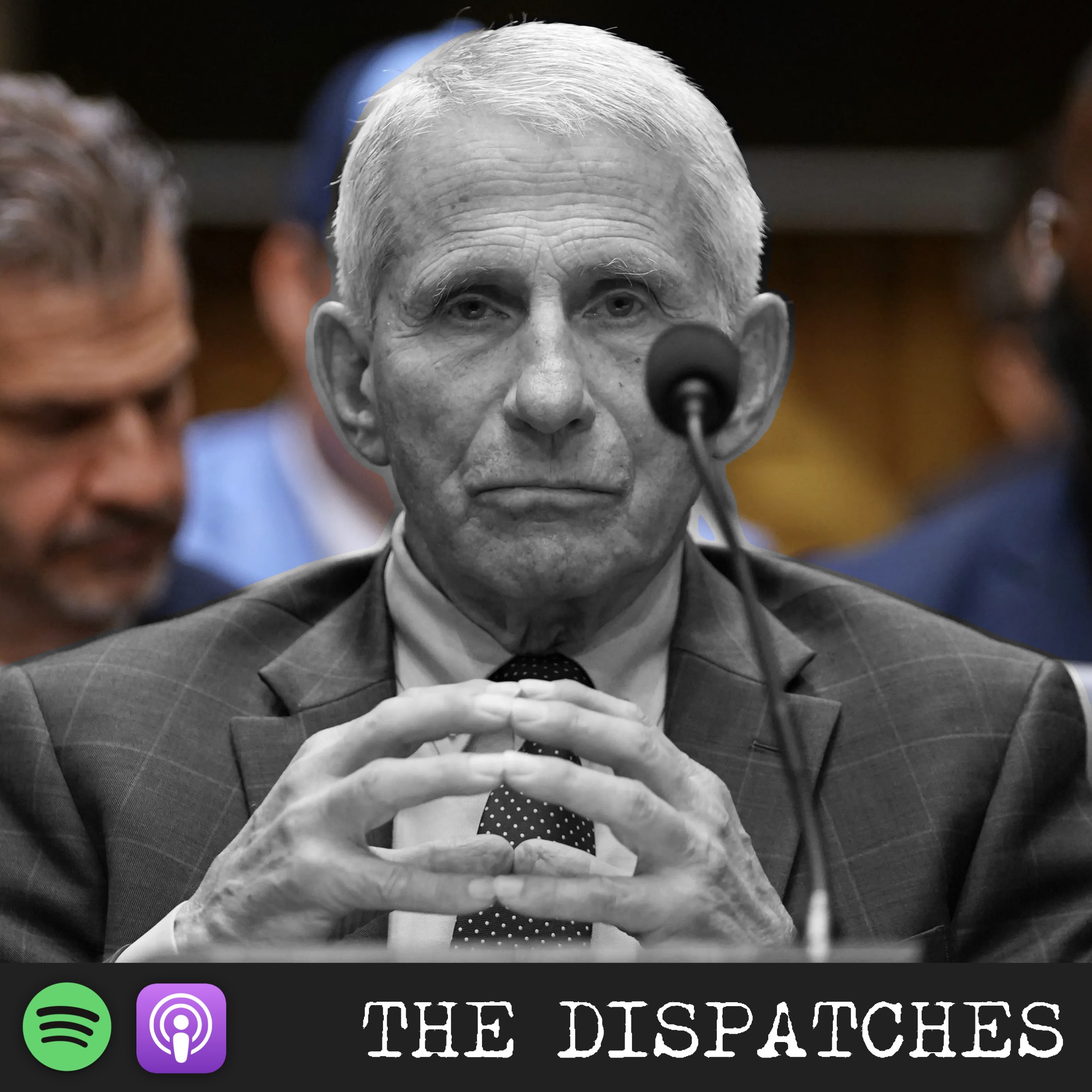
[00:00:04] Speaker A: Hi everybody. Welcome along to another episode of the Dispatchers podcast. My name is Brendan Malone. It is great to be back with you again. And today we're going to be talking about the Dr. Fauci trial. Not really the trial specifically, but some of the reactions to it and the fact that this clearly has reignited a problem that has not ever gone away. If you're a long time listener of my podcast, then and you will know that I have talked previously on more than one occasion about this particular issue and about the fact that we can't really ever move on from the COVID era mistakes until we actually acknowledge them as mistakes.
And it has been very interesting again over the past week or so to watch as clearly some very heated emotions and some old wounds have been reignited within people about the this issue.
And I have seen one of the reactions online that I've seen in particular, and that's why I wanted to make today's episode, is the staunch defenses that some are trying to mount of Dr. Anthony Fauci. Now, I'm not going to comment or go into whether or not I think this trial, if we want to call it that, of Fauci, is fair and balanced.
That's not really the focus of this episode today.
It's more about the fact that really he has become a lightning rod for people to respond to because he is, well, I mean, he probably globally was the most public face, the most well known face of the COVID pandemic.
And so he naturally is going to be a lightning rod. And here we are now with these hearings.
And to see him pleading the fifth, obviously has really sparked the ire of a lot of people. Others look at it with bemusement and they just think the whole thing looks like an absurd mockery when it comes to the question of accountability and learning from our mistakes, etc. And then there's a whole other group of people who are effectively trying to defend Fauci in the face of this and say that this is all nonsense, it's not fair. And I get it. Some of them are pointing to the fact that there are conspiracy theorists who are back now on the back of this, taking advantage of this. I'll get to that point later on, but that's to be expected. If you don't actually own your mistakes and work through these kinds of issues, I think in a humane and virtuous way, there is a vacuum created and that vacuum will be filled by all sorts of loud voices and all sorts of people who are trying to, trying to make sense of all of this. And so it's only natural that in the midst of all that uncertainty, confusion, and frustration, you will have conspiratorial thinking. It doesn't really do us any good to go back and relitigate all of that, or to just point the finger and say, these people are crazy. Even if they are crazy. The point is that there is something bigger here that needs our consideration that still remains unaddressed. And so when I see people online who are defending Fauci, and the consistent refrain that I have seen is that he was a genuine and very focused scientist who was doing his best to do science in the midst of an unprecedented and absolutely tumultuous situation.
Now, even if I take that premise, that claim as being valid, and you don't question any of it, there's still an issue here, because the reality is there was more than just science going on here. That's the bit that is missing, and that's the bit we need to consider.
And even if we were to take as read the claim that, you know, he and others of his ilk around the world were just doing their best in an unprecedented situation that was totally beyond their control, that seems to be a consistent refrain I'm hearing now.
But I would question that. I Look, for example, in my own country, previously, we've had plenty of conversations about pandemics and pandemic preparedness.
And then what we saw was we went off script, we moved away from those plans. And also, it was clear that we didn't really have a lot of the preparation in place that we should have had in place once an actual pandemic hit.
I guess a good comparison might be, imagine someone who has a interest rate for their mortgage and they decide to go with a floating interest rate, and they go, when things are great, things are really, really good, and they think, hey, we've got all this free money and they buy all this stuff and they spend up money instead of putting it on their mortgage, they spend the money on all sorts of other things instead. And then all of a sudden, the floating rate climbs and climbs and climbs. And when the floating rate climbs, that's obviously something that is beyond their control. Like Covid was beyond the control of those who found themselves having to deal with it. It's not like they caused this. They find themselves on the receiving end of something that you can't necessarily predict.
But if you're not prepared properly, and it's your job to be prepared, and if you then begin to do things which don't benefit your situation, like, for example, if we go back to the example of the mortgage, if we still, despite the fact that the interest rates have now skyrocketed, if we're still making all sorts of economic decisions secondary to our mortgage that are not actually helping us, it seems a bit irrational to then turn around and say, well, we were just doing our best. It was all beyond our control. There are things that are beyond your control, but then there's the question of how you respond to something that is beyond your control that confronts you. And that's where the deeper problem lies. And that's the bit that has to actually be confident, confronted and properly worked through. And we still haven't done that as a culture. And that's why this issue will not go away. So, for example, the fact that governments all around the world chose to utilise fear as a tool for behaviour modification in the public, and some of those claims that were made based on the use of fear were very extreme. That was never a healthy thing. As I said, all throughout that period during my podcasting, once you unleash fear as a tool in a situation like this, it's not something that easily goes back in the bottle and it's not really something that you can easily control. And we really saw the fruit of that. We saw things like the counting of homicides, like people who died by homicide as COVID deaths. We had at least one of those happened in our country. Then there was the issue of social distancing. And social distancing had two factors at play. First factor is that if you think solely in terms of we've got a physical illness here, then of course physical distancing is the only real thing that you're going to be concerned about.
But if you think more broadly and you consider that it's human persons and human communities and in which these potential transmissions take place, then all of a sudden you've got to weight other factors into the mix as well. And we didn't really do that. We certainly weren't particularly good at doing that, of considering, well, what are the implications for sustained periods of physical distancing between persons? What are the implications on mental health? What are the implications for society in general? And the. And so we didn't really weight things like that. But more importantly, the actual metric itself was not consistent from country to country. So you had a group of countries which were using 1 meter as the metric for their social distancing. Other countries had 1.5 metres. Other countries, I think America didn't they. They had like 1.8 metres or close to 2 metres.
But the reality is that this metric was not like a scientifically derived metric. The way it was explained to us was, well, if you've got at least a metre, that will help reduce transmission. And you can see the impetus behind this and you can see the implications of this. Obviously there's a bit of a problem here because you can't conduct ethical studies where you test this because that would involve deliberately exposing different groups of people to, to the actual virus itself. And so you could never ethically do that. So you don't really have an underpinning. You're sort of taking what you think is a best guess and a sort of a prudent based approach. But the problem is that we know it's not really that simple.
We know, for example, if you do look at the research, that it does depend a lot on what the activity is that you're engaging in. It also depends on the environment, indoors versus outdoors, what type of airflow and the. And things like that. We've also had research papers that were conducted during the COVID period which found that the virus was actually present in the air as far as four metres away from an infected person. The point is that we were given this hard and fast metric in our country and other countries had a different hard and fast metric, but it was a lot more complicated and nuanced than that. This is not actually what the science was saying, but the way it was presented was as if this was a scientifically verified metric. There wasn't even consensus on this particular point.
Now what makes this so noteworthy, I think, is it's a classic example of where the people who are doing the prudent best guessing because they are scientists.
The assumption then is that what they are doing is is science or that what they are saying to us has some sound, irrefutable scientific basis to it. Now, I don't really think this is anything that we should lose sleep over and it's certainly not something that anybody should be going to war over.
But the point is it was just one example of several whereby during that period we had more than just science happening. And that's the key thing to keep in mind. Vaccines and virus transmission. This was a really big one. The whole idea that being vaccinated would be preventative of virus transmission.
We know now for a fact that that had no scientific underpinning whatsoever. And then of course came things like vaccine mandates. Now, irregardless of how you feel about the moral question of mandating a vaccine, I have previously Produced a podcast episode in which I argue that morally speaking, there could be, if you were to do a thought experiment, there could well actually be a situation, depending on the nature of the virus or the nature of the illness, the nature of the vaccine, the seriousness of the situation, there could actually be a situation, a scenario in which it could be morally permissible to have mandated vaccines.
So that is not an intrinsically evil or wrong thing to do, irregardless of how you might feel about that. But we do know one thing from the previous scientific literature, and that is the moment you move from the carrot, which is encouraging and incentivizing with reward based incentives, people to use vaccination, the moment you move from that to a stick based incentive where you start punishing people, that's when you start to actually create problems for yourself. You get a worse outcome. From a public health policy and public health programming perspective, if you try and compel people by force instead of trying to incentivize them and encourage them in other ways.
And so there's always going to be a group of people who are going to get the vaccine. Irregardless, there will be people who then will need some sort of incentivization.
And there are a group of people who, the moment you start trying to compel them by force, they will then move away from the vaccine when otherwise they might well have actually got it. And so that was not something supported, that approach was definitely not something supported by science at all. And what we saw was a whole period of science and politics and in this incestuous relationship. And it was never clear where the boundaries actually lay. The lines were blurred all over the place.
We had this incestuous relationship between science and celebrity. And probably there's a couple of people like Dr. Ashley Bloomfield in our country.
He was a very clear example of that. It's not something that I have no indication or no sense that he ever sought this himself, but clearly he becomes caught up in that by default. But someone like Dr. Fauci was a. Was probably, globally speaking, the classic example of that. This incestuous relationship between science and celebrity with the lines were completely blurred and there was this idolatry going on in this worship. You saw this very clearly with Dr. Fauci. And the problem, of course, is the moment you were doing that is the moment you are checking reason and rationality at the door and that opens up the potential for all sorts of abuses. You know, the cult of personality, that is not science.
There was this relationship between science and corporate interests. These are things that exist in the day to day realities of medicine in our modern world. They are realities we have to live with.
In this case, though, those lines were blurred in a way that I just don't think was healthy at all.
And there's all sorts of questions that still circulate in my mind about that blurring of science and corporate interests. I think ultimately, what we see through this period of the COVID era and the mistakes that were made, because there were things that were done, I think were admirable and that were good and that was certainly virtuous in their intent.
But what we saw was we saw bureaucratised science and so we had science that was now married up to managerial bureaucracy. Managerialism stepped in and at that point, once that marriage unfolds and begins to sort of all the fruit of it begins to manifest, it's not really clear that science was in the driving seat so much anymore.
And the focus became on managed outcomes. And it certainly felt like a lot of the time science was the tool that would be used for the desired outcomes that they were trying to manage.
And you see this very clearly with something like Dr. Fauci and his condemnation of the group of scientists who were involved in the Great Barrington Declaration.
This was led by people like Dr. Sunitra Gupta, a professor at Oxford University, an epidemiologist with expertise in immunology, vaccine development and also mathematical modelling of infectious diseases. Dr. J. Bhattachara, professor at Stanford University Medical School, a physician, an epidemiologist, a health economist. These are not slouches and these people are not anti Covid conspiracy theorists.
Their proposal was that there should be focused protection.
And that declaration was signed by various experts from across the political spectrum, across the aisle, both left and right, in favour of that approach. But that wasn't just rejected, it was called evil by the likes of Dr. Fauci. This is not science.
And this is the point here. This is the key, I think with this defence of Fauci that I'm seeing is you can't really have it both ways.
You can't on the one hand say, well, they should be immune from scrutiny and from this level of scrutiny and prosecution, if you want to call it that, because they were just doing science, they were just scientists doing the best science they could in a very trying situation.
If at the same time, when they reject science and start doing politics and bureaucracy and other things instead, you want to turn around and say, well, no, they shouldn't be held accountable for that part of it.
You're trying to have your cake and eat it too. At that point, if it is science that's being done, then that's fair enough.
But the moment it moves beyond science, and that's absolutely what we did see during the COVID era, then it seems to me, absolutely, it is proper and fitting for there to be scrutiny and accountability.
Because how else do you ensure that science is safeguarded and remains neutral and can actually do what science is equipped to do if you don't hold people accountable for a lack of neutrality and for the moments where they overstep the boundary beyond science into politics, into celebrity, into bureaucracy, into these other areas?
Surely if you care about science, you want there to be proper scrutiny. And I get it. That scrutiny is naturally going to invite people who are going to want to throw all sorts of conspiratorial thinking into the mix as well. But that's just the price of doing business. This is the reality of living in a messy, imperfect human society.
You can't control for those things. You just got to live with that reality and work your way through that as well. And we have got to stop using it as an excuse, a justification, a moment of what aboutism. To avoid the important issue of learning from our mistakes, ensuring proper accountability, and ensuring that those who actually need to take responsibility for their actions truly do take responsibility.
And as a result, we can learn from what has happened and move forward in a much more fruitful way as a society?
Because from my perspective, the Fauci trial is emblematic of a deeper rot. And that deeper rot is the modern refusal to take responsibility and to lament and to be truly sorry, to actually be contrite and issue your apologies publicly for governance and leadership mistakes, it's just now baked into the system. And the more we move on like this and are not willing to acknowledge and change our behavior in this regard, the worse that problem is going to get.
And the reality is, in this particular situation, what happened during the COVID era policy making, we cannot ever begin to hope to move on from that and then move on from all of the conspiratorial thinking and everything else as well, until we actually do own the mistakes. And there is a proper sense of contrition for the harm that was done because there was harm done. Yes, you. You can point to good that was done as well. But pointing to the good while pretending that no harm happened is not honest.
And it's not helpful for human society, especially if you are one of those people who was on the receiving end of that harm, or your family was so in this country, that entailed things like people who lost their jobs. We know we lost people, key people out of healthcare. We had people. At least one case that has been publicly reported on of someone who died as a direct result of taking the vaccine because of the vaccine mandate. They took the vaccine because they were going to be getting married. And the vaccine mandate restrictions would not have allowed them to have full access to the wedding venue.
And as a result of this, this young man died. And his death has been, by our authorities, attributed to the vaccination that was what killed him and it was a fruit of the vaccine mandate.
There are lots of other things that we could talk about as well.
The families who were denied the ability to have just basic and humane things like funerals.
The families in this country who actually never got the last rights for their dying relatives because that was banned as well.
There were a lot of things here and a lot of mistakes that were made and hurts that were caused and harms that resulted.
And it's no good. Just saying, look, we're going to point to the good and ignore those harms until that actually happens, where we stop and acknowledge that and own it. And there is genuine remorse and a genuine public acknowledgement from authorities of mistakes. And yes, we need to do better in future, then we will not move on properly from the COVID mistakes, nor will science regain the trust that it so desperately needs to recover. So ironically, if you actually want to help public officials who are involved in the field of science in the future, the best thing we can do is actually be honest about the situation with Dr. Fauci, not play whataboutism and get sidetracked by obsessing about the conspiratorial thinking that arises in this moment as well. But instead focus on what is true and ensuring that there is proper accountability and that we learn, most importantly, from the mistakes that were made in order to.
To avoid making them again. Thanks for tuning in. Don't forget, live by goodness, truth and beauty, not by lies. And I'll see you next time on the Dispatchers.
[00:22:50] Speaker B: Hear me, Anthony.
I can't seem to find what I'm seeking misplaced all my love and way of thinking Carried in the current of the last year Help me, Anthony.
My mistakes are finally catching up I ignored the simple acts of love Let them rust all bundled up with green Whoa.
I'm sick of seeing all the times I chose the lie.
And tired of being reminded of my measured time to make things right.